
The reality of senior isolation among lonely seniors in San Francisco in 2026

At Care for Seniors, we walk into these homes every week. We see the empty kitchen table and the stack of unopened mail. We also see how fast life changes when someone shows up, sits down, and listens. This guide looks at the real scale of loneliness among Bay Area seniors. It shares fresh demographic data, a few numbers we calculated ourselves, and the people working to close the gap. For the broader picture, you can also read our companion guide on aging in San Francisco.
Key takeaways
- More than 122,000 San Franciscans are age 65 or older, and about 30.5% of them live alone. That is roughly 37,300 seniors in one-person homes.
- More than half of adults 60 and older in San Francisco are at risk of social isolation. That points to nearly 96,000 older residents.
- The U.S. Surgeon General calls loneliness an epidemic. Weak social connection raises the risk of early death about as much as smoking 15 cigarettes a day.
- By 2030, San Francisco could be home to nearly 169,000 residents 65 and older, with more than 51,000 living alone.
- Local groups such as the Institute on Aging Friendship Line, Little Brothers, San Francisco Village, Self-Help for the Elderly, TEL HI, and the Older Adult Social Club fight isolation every day. Demand still outpaces them.
- Steady, warm in-home companion care fills the gap between a weekly program and daily life.
What senior isolation in San Francisco really looks like
Loneliness and social isolation are not the same thing. Social isolation means a person has few contacts and little support. Loneliness is the painful feeling of being disconnected, even in a crowd. One senior can live alone and feel content. Another can sit in a full senior center and still feel unseen. Both states carry real risk.
In 2023 the U.S. Surgeon General named loneliness a public health crisis. The Surgeon General’s advisory on social connection reported that poor social connection raises the risk of early death by a margin similar to smoking 15 cigarettes a day. It also tied isolation to a 29% higher risk of heart disease, a higher risk of stroke, and a sharply higher risk of dementia. Older adults meet these risks more often because their social circles shrink. Friends pass away. Driving stops. Hearing fades. A flight of stairs becomes a wall.
San Francisco can make isolation easy. Many seniors live in walk-up buildings with no elevator. High rents push longtime neighbors away. Adult children often live across the country. Add a language barrier, and a person can feel cut off on their own block.
San Francisco senior demographics, a closer look
Here the numbers tell the story. San Francisco holds one of the densest older populations among large California cities. The U.S. Census counts about 122,295 residents age 65 and older, plus another 50,000 between 60 and 64. Together, adults 60 and older number close to 193,000, which is roughly one in five San Franciscans. If you want a wider view of the region, see our look at the best Bay Area cities for seniors.
| Senior isolation in San Francisco | Figure |
|---|---|
| Residents age 65 and older | ≈ 122,295 |
| Residents age 60 and older | ≈ 193,000 (about 1 in 5) |
| Seniors 65+ who live alone | 30.5% (≈ 37,300) |
| Adults 60+ at risk of social isolation | more than 50% (≈ 96,000) |
| Highest living-alone area (SoMa and Tenderloin) | 49.2% |
| Projected residents 65+ by 2030 | ≈ 169,000 |
Table 1. Sources: Justice in Aging (2023), U.S. Census ACS, and Care for Seniors analysis.
Older adults do not spread evenly across the city. Some neighborhoods hold far more solo households than others. The map of who lives alone closely matches the map of who calls us for companion care and wellness checks.
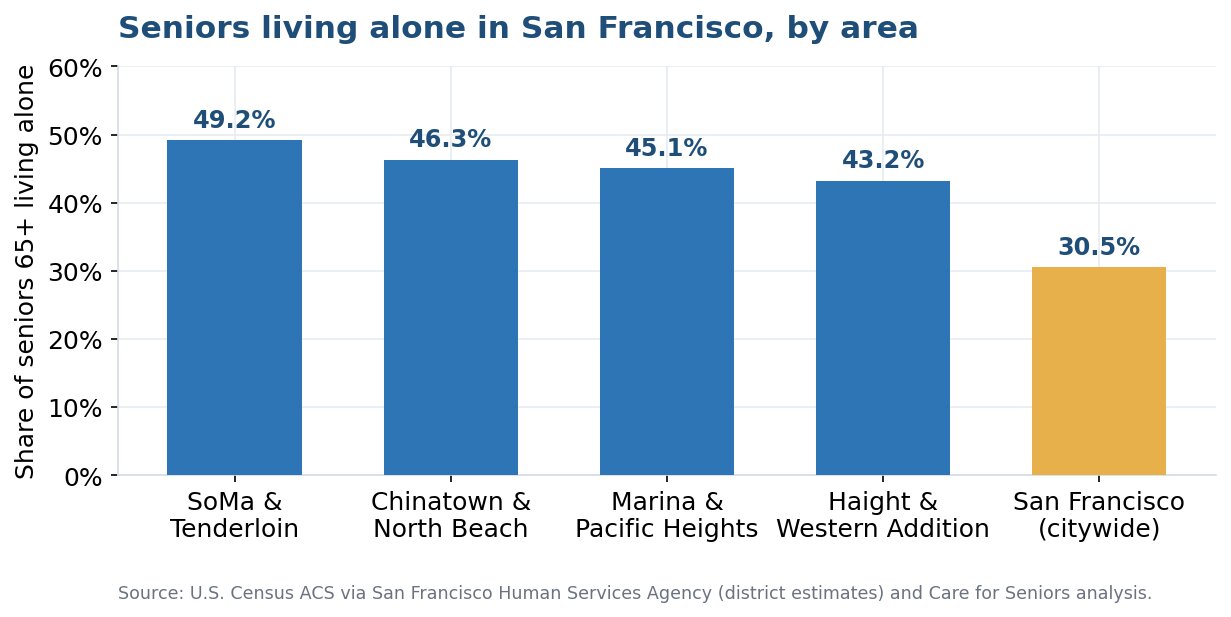
In the SoMa and Tenderloin area, nearly half of seniors 65 and older live alone. Chinatown and North Beach, the Marina, Pacific Heights, the Haight, and the Western Addition all sit far above the citywide rate. These dense, central neighborhoods carry the heaviest load of solo aging in San Francisco.
Our analysis: numbers we calculated from open sources
We wanted to push past the headline figures, so we ran a few simple calculations from public data. We show our method so you can check the math yourself.
First, the size of the at-risk group. Little Brothers reports that more than half of adults 60 and older are at risk of social isolation. San Francisco has about 193,000 residents in that age band. Apply that share, and the city holds nearly 96,000 older adults who face real isolation risk. That is a group larger than the entire population of San Mateo.
Second, the cost. The Surgeon General’s advisory ties social isolation among older adults to about $6.7 billion in extra Medicare spending each year, nationwide. San Francisco’s 122,295 seniors make up roughly 0.2% of the country’s older population. If isolation-linked costs track population, the city’s share lands near $14 million a year in avoidable Medicare spending. Connection is not only kind. It is also cheaper than the hospital.
Third, the trend. The San Francisco Health Improvement Partnership expects a 38% rise in residents 65 and older by 2030. We applied that growth to today’s count and held the living-alone rate steady at 30.5%.
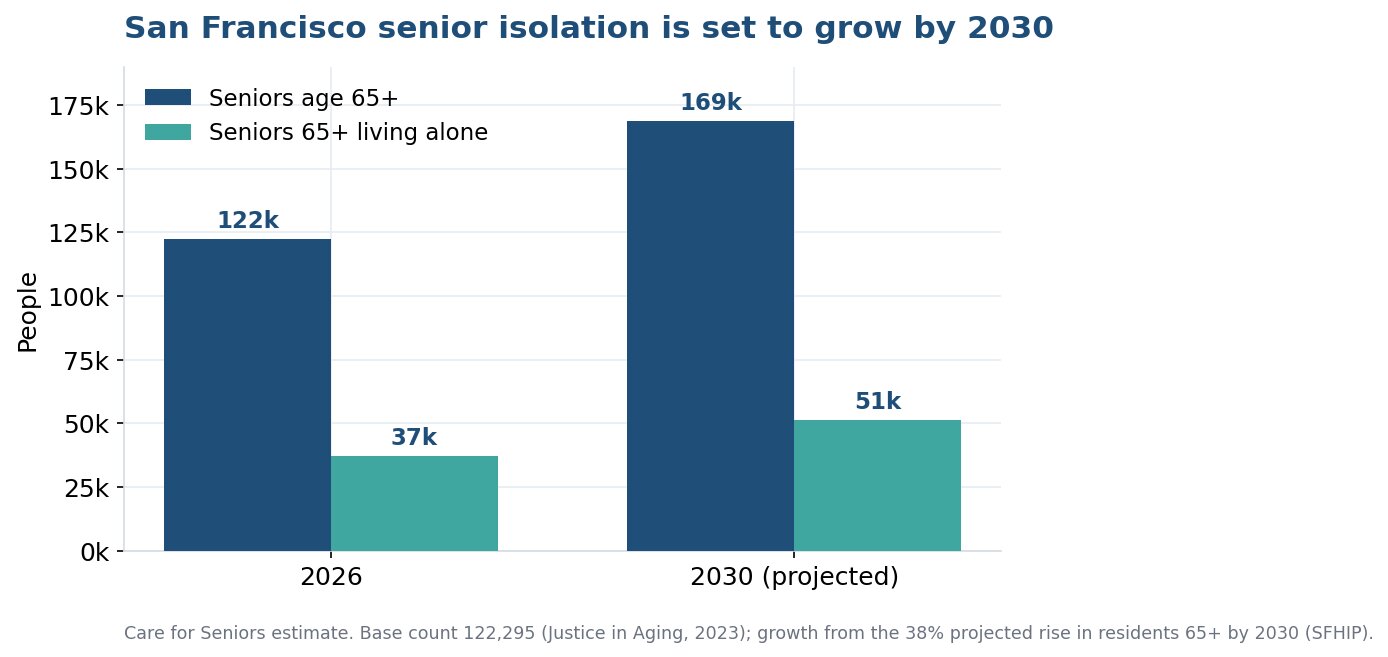
The result is striking. By 2030, the city could be home to about 169,000 seniors, with more than 51,000 living alone. That is roughly 14,000 more solo seniors than today. The need for connection will grow faster than almost any other care need in San Francisco.
| What our open-source analysis found | Estimate | How we got it |
|---|---|---|
| Older adults at risk of isolation | ≈ 96,000 | 50% (Little Brothers) applied to ~193,000 residents age 60+ |
| Avoidable Medicare cost tied to SF isolation | ≈ $14M / year | SF’s ~0.2% share of the national $6.7B (Surgeon General) |
| Residents 65+ by 2030 | ≈ 169,000 | 38% projected growth (SFHIP) on the 122,295 base count |
| Seniors living alone by 2030 | ≈ 51,000 | 30.5% living-alone rate held steady |
| New solo seniors added by 2030 | ≈ 14,000 | Difference between the 2026 and 2030 estimates |
Table 2. Care for Seniors estimates from open sources. Assumptions are stated so you can adjust them.
How San Francisco is fighting senior loneliness
The good news is that San Francisco does not look away. The city, local nonprofits, and ordinary neighbors all push back against isolation.
The city funds much of this work through the Dignity Fund, a voter-approved fund managed by the Department of Disability and Aging Services (DAS). The fund pays for senior centers, meals, case management, and social programs across the city. Every four years, DAS studies where the gaps are. The 2026 needs assessment again flagged isolation, and the struggle to navigate housing and health systems, as top concerns.
Money is tight, though. In 2026, a large city budget deficit put senior and disability programs on the chopping block, and advocates fought to protect them. As one community leader told the San Francisco Public Press during a budget hearing:
“An assumption that a lot of people have is that when you get to be a certain age, everything’s gonna be taken care of because we have this great aging system.”
— Vince Crisostomo
The truth is that the system leans on a web of dedicated nonprofits. Six stand out for fighting loneliness head on.
| Organization | Since | What it does | Who it serves |
|---|---|---|---|
| Institute on Aging Friendship Line | 1973 | 24-hour crisis and “warm line” by phone; about 11,000 calls a month | Adults 60+ and adults with disabilities, anywhere in the U.S. |
| Little Brothers, Friends of the Elderly | 1990 | Free home visits, meals, outings, and lasting friendships | Isolated SF elders (about 500 served by 1,000+ volunteers) |
| San Francisco Village | 2009 | Membership circles, activities, rides, neighbor-to-neighbor help | Adults 60+ across San Francisco |
| Self-Help for the Elderly | 1966 | Activity centers, affordable housing, meals, social services | Seniors citywide, strong Chinese-language support |
| TEL HI Neighborhood Center | 1890 | Senior wellness classes, community meals, gathering spaces | Older adults in North Beach and Chinatown |
| Older Adult Social Club (Felton Institute) | — | Group support, wellness activities, meals, and outings, all free | Socially isolated seniors who feel lonely |
Table 3. A snapshot of San Francisco organizations working to reduce senior loneliness.
The Institute on Aging Friendship Line is a lifeline you can call at any hour. Founded in 1973, it is the nation’s only accredited 24-hour crisis and warm line built for older adults and adults with disabilities. Trained staff and volunteers handle around 11,000 calls a month. You do not have to be in crisis to call. Sometimes a senior simply needs a voice.
Little Brothers, Friends of the Elderly has relieved isolation in San Francisco since 1990. Volunteers visit isolated elders at home, share meals and outings, and build friendships that last for years. The chapter reaches close to 500 elders with help from more than 1,000 volunteers, all at no cost.
San Francisco Village takes a neighbor-helping-neighbor approach. Founded in 2009, this membership group connects adults 60 and older through neighborhood circles, activities, and shared rides. Members give help when they can and receive it when they need it.
Self-Help for the Elderly has served the city since 1966. It runs senior activity centers, affordable housing, social services, and meals, with deep roots in Chinatown and strong support for Cantonese and Mandarin speakers.
TEL HI Neighborhood Center has anchored North Beach and Chinatown since 1890. Its senior program offers wellness classes, community meals, and gathering spaces that keep older neighbors active and connected.
The Older Adult Social Club, run by the Felton Institute, focuses on the emotional side of isolation. It offers group support, wellness activities, shared meals, and outings for lonely seniors. All activities are free, in person or online.
Where Care for Seniors fits in
Community programs are powerful, but most run on a weekly or monthly schedule. Loneliness does not keep a calendar. A senior can join a Tuesday lunch club and still spend the other six days alone. This is the gap we fill.
Care for Seniors provides warm, consistent in-home care across San Francisco, San Mateo, and Marin County. Our caregivers do more than tasks. They notice. They talk. They build trust over time.
- Companion care brings regular visits, conversation, and gentle wellness checks for seniors who live alone.
- Personal care and case management help with bathing, dressing, errands, and the maze of appointments and benefits.
- Hospital-to-home support watches over the risky first days after a fall, surgery, or discharge, when isolation turns dangerous fast.
- Dementia and Alzheimer’s care guides families through memory loss with patience and skill.
HOW CARE FOR SENIORS CAN HELP
We see ourselves as part of the safety net, not apart from it. We point families to the Friendship Line when they need a voice at 2 a.m. We tell them about San Francisco Village and Little Brothers. Then we provide the steady daily presence that ties it all together. If a loved one needs several kinds of help at once, our guide on coordinating multiple care services is a good place to start.
If you worry about an aging parent, spouse, or friend, you do not have to carry it alone. Reach out through our San Francisco, San Mateo, or Marin pages, and we will help you build a plan that fits real life.
Conclusion
Senior isolation in San Francisco is real, measurable, and growing. More than 37,000 seniors live alone today, and that number is climbing toward 51,000 by 2030. The health stakes are high. The financial stakes are high. Most of all, the human stakes are high, because no one should grow old feeling invisible.
The city, its nonprofits, and its neighbors are doing meaningful work. The Friendship Line answers the phone. Little Brothers knocks on the door. San Francisco Village builds community. Yet the need still outpaces the help. That is why steady, compassionate in-home care matters so much. It turns a statistic back into a person with a name, a story, and a reason to look forward to tomorrow. For more on where care is headed, read our overview of senior care trends in 2026.
“No one should grow old feeling invisible. Connection is care, and it is the most human service we offer.”
Don’t navigate senior isolation alone. Reach out to our care specialists to discuss what support looks like for your loved one.
Frequently asked questions
How many seniors in San Francisco live alone?
About 30.5% of San Francisco residents 65 and older live alone, which is roughly 37,300 seniors. In neighborhoods like SoMa, the Tenderloin, and Chinatown, the share climbs close to half.
Is senior isolation really a health risk?
Yes. The U.S. Surgeon General links weak social connection to a higher risk of heart disease, stroke, dementia, and early death. The danger to lifespan is similar to smoking 15 cigarettes a day.
What free resources help lonely seniors in San Francisco?
Several. The Institute on Aging Friendship Line offers 24-hour phone support. Little Brothers and San Francisco Village offer visits and community. Self-Help for the Elderly, TEL HI, and the Older Adult Social Club run senior programs and social activities. Most services are free or low cost.
What is the difference between loneliness and social isolation?
Social isolation describes a lack of contacts and support. Loneliness is the painful feeling of being disconnected. A person can have one without the other, and both can harm health.
How does in-home companion care reduce isolation?
A caregiver visits on a regular schedule. They talk, share meals, help with errands, and watch for warning signs. That steady presence breaks the cycle of empty days and gives families peace of mind. Learn more about our companion care.
Which San Francisco neighborhoods have the most seniors living alone?
SoMa and the Tenderloin lead, near 49%. Chinatown, North Beach, the Marina, Pacific Heights, the Haight, and the Western Addition also sit well above the citywide rate.
Does Care for Seniors serve my area?
We serve San Francisco, San Mateo, and Marin County. If you live nearby, call us anyway. We will help you find the right care, even if it is not with us.
Related reading
- Aging in San Francisco: Key Statistics and Care Options in 2026
- Senior Care Trends in 2026
- How Families Can Coordinate Multiple Care Services for an Aging Parent
Sources
- U.S. Surgeon General, Our Epidemic of Loneliness and Isolation (2023)
- Justice in Aging, Snapshot of Older Adults in San Francisco County (2023)
- San Francisco Health Improvement Partnership, Demographics
- Little Brothers, Friends of the Elderly, Our Impact
- Institute on Aging, Friendship Line California
- San Francisco Village
- Self-Help for the Elderly
- TEL HI Neighborhood Center
- Felton Institute, Older Adult Social Club
- San Francisco DAS, The Dignity Fund
- San Francisco Public Press, budget coverage (2026)
- Local News Matters, The Geography of Aging (2025)
Note on data: figures combine multiple U.S. Census ACS releases and public reports. Estimates are clearly labeled and use stated assumptions, so exact percentages may shift slightly year to year.

Related posts
Popular Posts


Testimonials
I was extremely pleased with the in-home care I received from your employee, Zanaida Beltran. Zenaida is a highly competent caregiver who is very instrumental in fulfilling my needs after I suffered a fractured pelvis. At all times she was prompt in arriving, knew how to perform her duties intelligently and did all with a most pleasant manner. Zenaida anticipated what was necessary and went beyond normal circumstances making my surrounding appropriately safe and clean. She also made sure that I followed the instructions of my doctors and physiotherapist. Upon accompanying me to appointments, she assisted with all transfers from car or cab. I felt confidant-having Zenaida with me. I am positive that Zenaida’s help during the first days of my confinement has been instrumental in my eventually achieving a full recovery from my accident. Thank you for sending such a valuable caregiver.

I wanted to put in writing what a lifesaver Care for Seniors was for us. My husband and I found ourselves in the unexpected situation for both being in the hospital at the same time. Len was going to be released before me but still needed a caregiver when he arrived home. I was not going to be home for a few days but I was also going to need help recovering from my chemotherapy treatment. It was 3:00pm in the afternoon when the agency was contacted and amazingly they were able to get us a live in caregiver by 6:00pm that same day. I shudder when I think back on that day and how vulnerable and helpless I felt. Thanks to you, Alla and Care for Seniors staff, our needs were met with compassion and understanding. Thank you so much! It’s comforting to know that we seniors have a safe and reliable place to turn for help.

I am so grateful for all your services. My mother was cared for with compassion, attention, dignity, and integrity. A special commendation is deserved by Maria Regina Garcia. Gina went way above her responsibilities in caring for my mother. My mother grew to love her. I frequently observed Gina holding my mother’s hand and stroking her hair. In the hours immediately prior to my mother’s death on July 19th 2009, Gina sat with her through the night ensuring that at every stage in the process, my mother would be comfortable. My cousin who shared some time with her that evening told me that Gina was caring and tearful, two attributes for which Gina is to be treasured. Living so far from my mother, it was always my intent that she not die alone or in pain. To some extent, my cousins in the Bay Area assisted with that. However, Gina ensured that my mother’s last few months would be shared with an attentive, compassionate, and caring individual. Within minutes of my mother’s death, Gina called me here in Georgia to notify me. Gina stayed with my mother until my mother was transported from Rhoda Goldman Plaza. I will always remember the service of your caregivers, but particularly Gina. You should consider her a treasured asset.

Thank you so much for your help and support during Joe’s ordeal. You couldn’t have helped more, and your energetic and cheerful presence was an added comfort. I am recommending Care for Seniors to SF Village very highly. I hope we cross paths again in happier times.

I wanted to express my appreciation for the excellent service you provided in helping my mother during the past two years. You and your office staff were always available and wonderfully responsive to last minute changes and emergencies as they arose. Your Caregivers were sensitive and competent, especially considering my mother’s many special requirements. She was very pleased with their effort, ability and affection. I can strongly recommend Care for Seniors as a reliable, competent and effective service in caring for the elderly. Best wishes to you and all your Staff.

I want to thank you and all your staff for your care for Bob and being so responsive and helpful. I would gladly recommend Care for Seniors to any families who want kind and caring support for their loved ones.

I wanted to express my appreciation for the excellent service you provided in helping my mother..

I want to thank you and all your staff for your care for Bob and being so responsive and helpful..
I wanted to put in writing what a lifesaver Care for Seniors was for us. My husband and I found ourselves..