
Aging in San Francisco: key statistics, real costs, and care options for Bay Area seniors in 2026

AGING IN THE BAY AREA
San Francisco is growing older. More than 193,000 of our neighbors are now age 60 or older, and 122,295 are 65 and up. That means roughly one in five San Franciscans belongs to the senior community we proudly serve.
But aging here is not one story. A 70-year-old in the Sunset lives a very different life than one in the Tenderloin or on Russian Hill. Some seniors own homes worth millions. Others stretch every Social Security check to make rent. At Care for Seniors, we walk into both kinds of homes every week, and the data confirms what families tell us at the kitchen table.
This guide breaks down what the numbers say about aging in San Francisco — and what good care looks like in response.
Key takeaways
- More than 122,000 San Franciscans are age 65 or older — about 14.4% of the city.
- 46% of older adults 65+ in San Francisco do not earn enough to meet basic needs (UCLA Elder Index).
- A single senior who rents in San Francisco needs at least $45,348 a year to live safely.
- About 30% of San Francisco seniors live alone. In some districts, that share reaches 49%.
- Roughly 37% of seniors 65+ report a disability that affects daily life.
- Nearly 20,000 SF seniors rely on In-Home Supportive Services (IHSS) to stay in their homes.
A snapshot of the senior population of San Francisco
San Francisco has one of the densest concentrations of older adults among California’s major cities. The U.S. Census counts 122,295 city residents age 65 and older, plus another 50,000 between 60 and 64. Together, they make up just over 20% of San Francisco.
Women outnumber men in this group. About 54% of San Francisco seniors are female — a gap that widens at older ages, because women tend to live longer.
San Francisco County now counts roughly 193,000 adults age 60 and older. That’s a population larger than the cities of Berkeley and Daly City combined.
| San Francisco seniors at a glance | Figure |
|---|---|
| Adults age 60+ in San Francisco County | ~193,000 |
| Adults age 65+ in San Francisco | 122,295 |
| Share of city residents age 60+ | ~20.3% |
| Seniors 65+ who live alone | 30.5% (≈37,300) |
| Seniors 65+ who report a disability | ~37% (≈44,700) |
| Seniors 65+ short on income to meet basic needs | 46% |
| Annual income a single SF renter senior needs (Elder Index) | $45,348+ |
| SF seniors 65+ on IHSS (In-Home Supportive Services) | 19,653 |
| SF seniors dually eligible for Medi-Cal + Medicare | 52,625 |
Where seniors live in San Francisco
Older adults are not spread evenly across the city. Some neighborhoods hold far more seniors than others, and the differences shape what good care looks like.
Chinatown, North Beach, and Russian Hill lead with nearly 25% of residents age 60 or older. The Sunset, West of Twin Peaks, and Richmond areas also carry very high senior concentrations. Each neighborhood brings its own care needs: the Sunset has many Cantonese-speaking households, North Beach has many seniors living alone in walk-up apartments, and the West Side has more homeowners with adult children nearby.
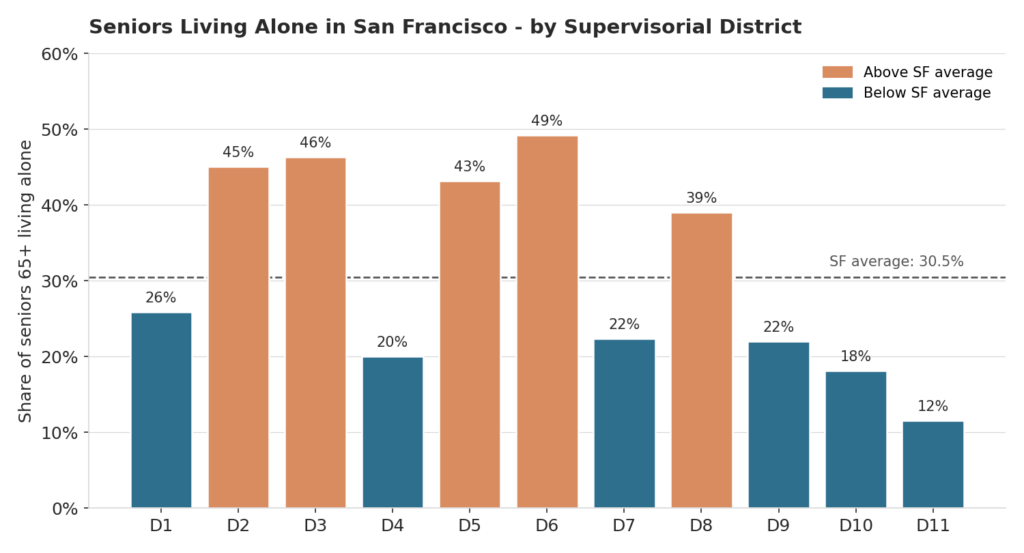
Source: American Community Survey 2016 5-Year Estimates, Table B16004 (SF HSA, 2018).
We see this pattern clearly when we look at who lives alone. Several central and western neighborhoods sit far above the citywide rate. These are also the neighborhoods where we get the most calls for companion care and wellness checks.
The financial reality of aging in San Francisco
This is where the data hits hardest. San Francisco is one of the most expensive places in America to grow old.
The UCLA Elder Index measures what a senior actually needs — rent, food, healthcare, transportation. The San Francisco number is sobering:
A single older adult who rents in San Francisco County needs at least $45,348 per year just to meet basic needs. That’s more than $3,700 every month — before a single coffee or medication co-pay.
Yet 46% of San Francisco seniors fall short of that mark. That share is far higher than the 33% statewide rate. About 26,000 city seniors receive Supplemental Security Income (SSI), and 52,625 are dually eligible for Medi-Cal and Medicare — the strongest signal of low income.
The picture changes block by block across the Bay Area:
| County | Share age 65+ | Median senior income | Senior homeownership |
|---|---|---|---|
| Marin | 23.3% | $101,385 | 60.4% |
| Mendocino | 24.0% | $62,168 | 48.9% |
| Santa Cruz | 18.3% | $85,104 | 41.9% |
| Sonoma | 21.0% | $78,826 | 41.2% |
| Solano | 16.9% | $76,117 | 34.2% |
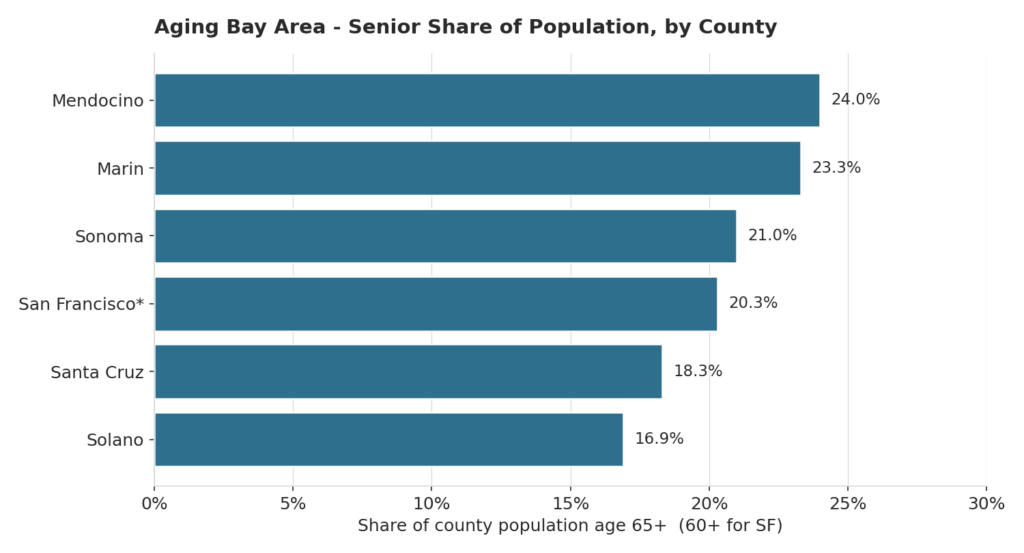
Sources: U.S. Census 2023 5-Year Estimates (Bay City News, 2025); Justice in Aging (SF County, 2023). SF figure is share age 60+.
In San Francisco itself, the spread is wider than these county-level numbers suggest. Some of our clients live with abundance. Many more do the math each month and choose between food and a medication refill.
The quiet risk of living alone in Bay Area
About 30.5% of San Francisco seniors 65 and older live alone. In some districts, that number nearly doubles:
- SoMa, Tenderloin: 49.2% live alone
- Chinatown, North Beach: 46.3%
- Marina, Pacific Heights: 45.1%
- Haight, Western Addition: 43.2%
Living alone is not the same as being lonely — many of our clients love their independence. But isolation raises real risks. Seniors who live alone fall more often, miss medications more, skip meals more, and stay undiagnosed longer when something changes.
This is one reason we built our companion care service. A few warm, attentive hours each week can change how an older adult eats, moves, and feels — and gives families peace of mind.
Health, disability, and daily life of seniors in Bay Area
Roughly 37% of seniors 65+ in San Francisco report a disability that affects daily life. It’s about 44,700 people. The most common challenges are:
- Walking or climbing stairs (about 44%)
- Independent living, such as errands or doctor visits (about 36%)
- Cognitive challenges, including memory
- Self-care, such as bathing or dressing (about 18%)
For the families who call us, these numbers translate into very concrete needs. Many begin with Personal Care for bathing and dressing. Some add Hourly or 24-Hour Home Care when one caregiver can no longer manage alone. Others need Hospital-to-Home support after a fall or surgery.
We also see a steady rise in cognitive care. Memory loss does not respect zip codes or income brackets. Our Dementia Care and Alzheimer’s Care programs guide families through what is often the hardest stretch of life — and we walk it with them.
Language and cultural diversity of seniors
San Francisco’s seniors are wonderfully diverse, and that diversity shapes how care must be delivered. Among seniors 65+:
- 43.6% are Asian or Pacific Islander
- 40.1% are White (non-Hispanic)
- 9.2% are Latino or Latina
- 6.1% are African American
Almost 31% of San Francisco seniors speak English “not well” or “not at all.” In some districts, the share is nearly half. Care delivered without language and cultural awareness simply does not work. Good care meets seniors where they live — in Cantonese, Spanish, Tagalog, Russian, or any other language that feels like home.
Who’s holding the safety net?
Three programs do much of the heavy lifting for lower-income San Francisco seniors:
- In-Home Supportive Services (IHSS): 19,653 SF seniors 65+ receive this support so they can stay in their own homes.
- Medi-Cal + Medicare (dually eligible): 52,625 seniors qualify for both.
- Supplemental Security Income (SSI): 26,236 city seniors receive these payments.
These programs help, but they don’t cover everything. Families often layer private home care, family help, and community support on top. That’s where we come in. We help families navigate the patchwork, understand what’s possible, and build a plan that fits the loved one’s actual life.
How we help: care yhat matches the need
Care for Seniors company built our services around what San Francisco families actually face:
- Companion сare for seniors who live alone and need warmth and watchfulness.
- Personal сare for help with bathing, dressing, and daily tasks.
- Hourly and 24-hour home care for flexible schedules or full-time support.
- Hospital-to-home support during the risky days after discharge.
- Specialty care for dementia, Alzheimer’s, Parkinson’s, post-stroke, and post-surgery recovery.
- Hospice support when comfort and presence matter most.
- Facility referrals when home is no longer the right place — and families need an honest guide.
We serve San Francisco, San Mateo, and Marin County. We answer the phone when families call. And we never forget that behind every statistic in this article is a real person with a real story.
Conclusion: a region that needs thoughtful care
San Francisco’s seniors are growing in number, in diversity, and in need. The data is clear: nearly half of older adults in our city do not have enough income to live safely. One in three lives alone. More than one in three has a disability. And most want to stay in the home they love.
Good care is the bridge between those wishes and that reality. It listens. It shows up. It adjusts as life changes.
If you are caring for an aging parent, spouse, or friend in San Francisco, San Mateo, or Marin — you do not have to figure it out alone. Call us. We will help you build a plan that works and walk beside you as it unfolds.
Frequently Asked Questions
How many seniors live in San Francisco?
San Francisco is home to more than 193,000 adults age 60 and older, including 122,295 who are 65+. Together, they make up just over 20% of the city’s population.
What percentage of San Francisco seniors live in poverty?
About 46% of San Francisco residents 65 and older do not earn enough to cover basic needs, according to the UCLA Elder Index. The federal poverty measure shows a lower 13.7%, but the Elder Index reflects the city’s real cost of living.
How much income does a senior need to live in San Francisco?
A single senior who rents needs at least $45,348 per year to meet basic needs in San Francisco County. That number rises for couples or for those with higher medical costs.
What is IHSS in San Francisco?
In-Home Supportive Services (IHSS) is a California program that pays caregivers to help eligible low-income seniors and people with disabilities at home. About 19,653 San Francisco seniors 65+ receive this support.
Which San Francisco neighborhoods have the most seniors?
District 3 (Chinatown, North Beach, Russian Hill), District 4 (Sunset), District 7 (West of Twin Peaks), and District 1 (Richmond) have the highest senior populations as a share of residents.
Where does Care for Seniors serve?
We serve San Francisco, San Mateo, and Marin County. If you live nearby and need guidance, please call us — we will help you find the right care, even if it isn’t with us.
Sources
- Justice in Aging, “Snapshot of Older Adults in San Francisco County” (2023)
- San Francisco Human Services Agency, “SF Senior and Disability Population Demographics by Supervisorial District” (ACS 2016 5-Year, published 2018).
- Bay City News / Local News Matters, “The Geography of Aging” (September 23, 2025).
- U.S. Census Bureau, American Community Survey 5-Year Estimates.
Note on data vintage: figures combine multiple ACS releases. Trends remain consistent; exact percentages may shift slightly year to year.
“Navigating senior wellness, localized care options, and the true cost of eldercare in San Francisco requires up-to-date, hyper-local data.”
Explore our comprehensive 2026 breakdown of Bay Area senior demographics, real marketplace costs, and strategic care options to plan confidently for your family’s future.
Access the Aging in San Francisco 2026 PDF
Related posts

Popular Posts


Testimonials
I was extremely pleased with the in-home care I received from your employee, Zanaida Beltran. Zenaida is a highly competent caregiver who is very instrumental in fulfilling my needs after I suffered a fractured pelvis. At all times she was prompt in arriving, knew how to perform her duties intelligently and did all with a most pleasant manner. Zenaida anticipated what was necessary and went beyond normal circumstances making my surrounding appropriately safe and clean. She also made sure that I followed the instructions of my doctors and physiotherapist. Upon accompanying me to appointments, she assisted with all transfers from car or cab. I felt confidant-having Zenaida with me. I am positive that Zenaida’s help during the first days of my confinement has been instrumental in my eventually achieving a full recovery from my accident. Thank you for sending such a valuable caregiver.

I wanted to put in writing what a lifesaver Care for Seniors was for us. My husband and I found ourselves in the unexpected situation for both being in the hospital at the same time. Len was going to be released before me but still needed a caregiver when he arrived home. I was not going to be home for a few days but I was also going to need help recovering from my chemotherapy treatment. It was 3:00pm in the afternoon when the agency was contacted and amazingly they were able to get us a live in caregiver by 6:00pm that same day. I shudder when I think back on that day and how vulnerable and helpless I felt. Thanks to you, Alla and Care for Seniors staff, our needs were met with compassion and understanding. Thank you so much! It’s comforting to know that we seniors have a safe and reliable place to turn for help.

I am so grateful for all your services. My mother was cared for with compassion, attention, dignity, and integrity. A special commendation is deserved by Maria Regina Garcia. Gina went way above her responsibilities in caring for my mother. My mother grew to love her. I frequently observed Gina holding my mother’s hand and stroking her hair. In the hours immediately prior to my mother’s death on July 19th 2009, Gina sat with her through the night ensuring that at every stage in the process, my mother would be comfortable. My cousin who shared some time with her that evening told me that Gina was caring and tearful, two attributes for which Gina is to be treasured. Living so far from my mother, it was always my intent that she not die alone or in pain. To some extent, my cousins in the Bay Area assisted with that. However, Gina ensured that my mother’s last few months would be shared with an attentive, compassionate, and caring individual. Within minutes of my mother’s death, Gina called me here in Georgia to notify me. Gina stayed with my mother until my mother was transported from Rhoda Goldman Plaza. I will always remember the service of your caregivers, but particularly Gina. You should consider her a treasured asset.

Thank you so much for your help and support during Joe’s ordeal. You couldn’t have helped more, and your energetic and cheerful presence was an added comfort. I am recommending Care for Seniors to SF Village very highly. I hope we cross paths again in happier times.

I wanted to express my appreciation for the excellent service you provided in helping my mother during the past two years. You and your office staff were always available and wonderfully responsive to last minute changes and emergencies as they arose. Your Caregivers were sensitive and competent, especially considering my mother’s many special requirements. She was very pleased with their effort, ability and affection. I can strongly recommend Care for Seniors as a reliable, competent and effective service in caring for the elderly. Best wishes to you and all your Staff.

I want to thank you and all your staff for your care for Bob and being so responsive and helpful. I would gladly recommend Care for Seniors to any families who want kind and caring support for their loved ones.

I wanted to express my appreciation for the excellent service you provided in helping my mother..

I want to thank you and all your staff for your care for Bob and being so responsive and helpful..
I wanted to put in writing what a lifesaver Care for Seniors was for us. My husband and I found ourselves..