Post-stroke home support for better recovery

Coming home after a stroke feels like a relief — and a shock at the same time. The hospital stay is over, but the hard work is just beginning. For many stroke survivors and their families, the first weeks at home are the most disorienting part of the whole experience.
Suddenly, the medical team isn’t right down the hall. Therapy appointments happen a few times a week, not every day. And the daily tasks of life — bathing, dressing, moving around the house, making meals — require far more help than anyone expected.
Care for Seniors caregivers support stroke survivors and their families through this transition with dependable, compassionate, non-medical home care. We help the recovery period feel manageable, and we give family caregivers the relief they genuinely need.
What typically happens after a stroke patient is discharged
Most stroke survivors spend some time in the hospital after the event — often followed by a short stay in an inpatient rehabilitation facility. When they come home, they usually have a plan: outpatient therapy appointments, follow-up visits with their neurologist or primary care doctor, and a list of home exercises to work on between sessions.
That plan is solid on paper. But it assumes the senior can manage their daily routine with minimal help. For many stroke survivors, that assumption doesn’t hold — especially in the first few months.
Physical strength and coordination may still be limited. Fatigue hits hard and unpredictably. Cognitive changes can make it difficult to follow instructions, remember schedules, or stay safe alone at home. Family members often find themselves providing round-the-clock support without any training or backup.
This is exactly the gap that post-stroke home care is designed to fill.
The most common daily challenges of stroke recovery at home
Physical mobility, transfers, and fall risk
Many stroke survivors experience weakness or paralysis on one side of the body. Walking safely, getting in and out of bed, using the bathroom, and navigating stairs all become genuinely risky activities.
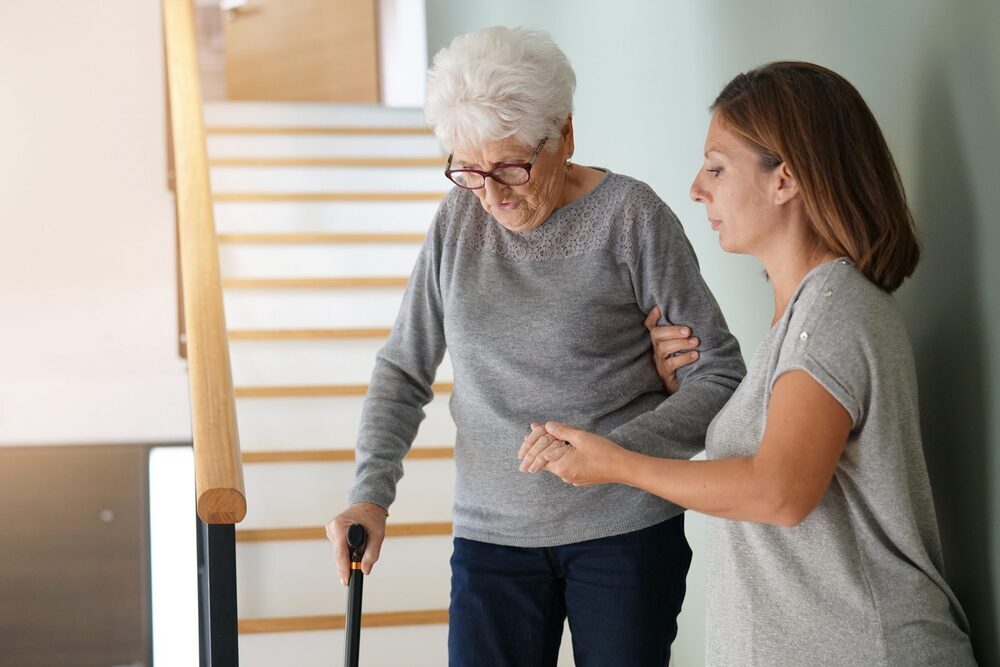
Falls are one of the most serious concerns during post-stroke recovery. A fall can set recovery back significantly — or cause a new injury that complicates everything. Stroke survivors often need hands-on assistance or steady supervision for transfers and movement throughout the day.
Communication difficulties and cognitive changes
Stroke can affect speech, language, and memory in ways that vary widely from person to person. Some survivors struggle to find words. Others have difficulty understanding what’s being said. Some experience changes in attention, judgment, or the ability to follow a sequence of steps.
These challenges affect daily life in quiet but constant ways. Getting dressed becomes more complicated. Following a medication schedule requires more support. Even a simple conversation can require patience and a specific kind of communication.
Emotional adjustment — frustration, low mood, withdrawal
Stroke recovery is emotionally difficult. Many survivors feel frustrated by what they’ve lost, frightened about the future, and isolated from their normal lives. Depression is genuinely common after stroke — not a character flaw, but a medical reality.
Withdrawal from social interaction makes recovery harder. Motivation for home exercises drops. Family relationships come under strain. Having consistent, warm human presence at home can make a meaningful difference during this period.
What non-medical home care covers after stroke
Personal care assistance — bathing, dressing, grooming
Our caregivers provide hands-on help with the personal care tasks that stroke survivors often need most. Bathing safely when balance is compromised. Getting dressed when one side of the body isn’t cooperating. Grooming with dignity and patience.
We adapt to each person’s abilities and limitations. We support independence wherever it’s possible and provide more help where it’s needed. Every interaction is handled with respect — because how a person feels during personal care matters as much as whether the task gets done.
Encouragement during home exercise routines (not therapy)
Physical, occupational, and speech therapists prescribe home exercise programs for good reason — consistent practice between sessions drives recovery. The challenge is that many stroke survivors struggle to stay motivated or remember the routine on their own.
Our caregivers can encourage and support home exercise routines that the therapy team has already prescribed. We can remind the senior when it’s time, sit with them while they work through exercises, and offer calm encouragement when it feels hard.
We do not conduct therapy, modify exercises, or make clinical decisions. That work stays entirely with the licensed rehabilitation team. But we make sure the environment at home supports what the therapists are working toward.
Medication reminders and scheduling
After a stroke, medication adherence is important. Many survivors take multiple medications on a careful schedule. Cognitive changes can make it easy to forget a dose — or to take one twice.
Our caregivers provide medication reminders to help seniors stay on schedule. We do not administer medications or manage prescriptions. But we make sure the senior knows when it’s time, and we can help organize the environment so medications are visible and accessible.
Companionship and reducing isolation during recovery
Recovery is slow, and the days at home can feel very long. When a stroke survivor loses their independence, their social world often shrinks too. They can’t drive. They may feel embarrassed about speech or physical changes. Visitors may not know what to say.
Our caregivers show up as consistent, warm company. They talk, listen, watch television together, take short walks, or simply share the room. This kind of companionship during stroke recovery reduces isolation, supports emotional wellbeing, and keeps the senior engaged with life during a very difficult chapter.
What caregivers do not do — and who handles the clinical side
We want to be completely clear about the boundaries of our role. Our caregivers are not nurses or therapists, and they do not perform clinical tasks.
Our caregivers do not:
- Conduct physical, occupational, or speech therapy
- Monitor or record vital signs (blood pressure, oxygen levels, etc.)
- Manage wound care or post-surgical sites
- Adjust medications or make decisions about medical treatment
- Provide skilled nursing care of any kind
All clinical care belongs to the licensed professionals on the senior’s medical team — the neurologist, primary care physician, physical therapist, occupational therapist, and any other specialists involved.
Our role is to handle the practical, daily, human side of life at home. We take that role seriously, and we stay within it.
How family caregivers fit into stroke recovery and where they need relief
Family members do extraordinary things after a loved one’s stroke. Spouses rearrange their lives entirely. Adult children take time off work, drive to endless appointments, and learn to help with transfers and personal care on the fly.
This love is real — and it has limits. Caregiver burnout after stroke is extremely common. When a family caregiver is exhausted, anxious, or overwhelmed, the quality of care suffers. Their own health suffers. Relationships suffer.
We provide respite and transition support so family caregivers get regular breaks without leaving their loved one unsupported. We can step in for a few hours a day, full days, overnights, or more — whatever the family needs.
Asking for help is not giving up. It’s what makes sustainable care possible.
Warning signs that homesupport needs to be increased
Sometimes the initial level of home care isn’t enough. Here are signs that a stroke survivor may need more support:
- Increasing fall risk — near-misses, stumbles, or actual falls at home
- Missed medications or difficulty managing a schedule independently
- Significant fatigue that prevents participation in therapy or daily activities
- Cognitive changes that make it unsafe to be alone for extended periods
- Growing withdrawal — refusing to engage, canceling therapy, isolating from family
- Family caregiver showing signs of burnout — irritability, exhaustion, anxiety, or health problems
If any of these apply, reach out. We can increase care hours quickly, sometimes the same day.
Planning home care before hospital discharge — a practical checklist
The best time to arrange stroke discharge home support is before the senior comes home, not after. Hospitals often have discharge planners who can help coordinate the transition, but families need to ask proactive questions.
Here’s a practical checklist:
- Talk to the discharge planner about what level of home support the senior will need
- Contact a home care agency before discharge — we can often start care the same day or within 24–48 hours
- Review the home environment for fall hazards — loose rugs, poor lighting, difficult bathrooms
- Confirm therapy appointments and transportation to get there
- Clarify medication instructions with the hospital team before leaving
- Discuss overnight needs — some stroke survivors need support during the night, especially in the early weeks
- Set up a communication plan between the home care team and the rehabilitation team
You don’t have to figure this out alone. We work with families during the hospital-to-home transition and can help think through what’s needed before day one at home.
Post-stroke home support in the Bay Area
We serve stroke survivors and their families across the Bay Area with experienced, carefully matched caregivers. We have placed caregivers with post-stroke clients specifically — we understand the mobility challenges, the communication adjustments, the emotional weight of this recovery period.
We can start care quickly after discharge. We offer flexible hours including overnight and 24-hour support for clients with high fall risk or nighttime confusion. And we communicate openly with families and, when appropriate, with rehabilitation teams and discharge planners.
If you’re coordinating care after a stroke — for a parent, a spouse, or yourself — we’re ready to talk. No pressure, no rush. Just a real conversation about what would help.
Conclusion
Stroke recovery at home is a long process, and it rarely goes smoothly without support. The medical team handles the clinical side. Therapy handles rehabilitation. But the daily layer of life — personal care, safe mobility, consistent company, meal preparation, medication reminders — needs someone to cover it too.
That’s what we do at Care for Seniors. We show up every day, do the practical work that recovery depends on, and make the home environment feel safer and warmer.
If your family is navigating the weeks or months after a stroke, reach out. We’re here to help you get through this — one day at a time.

Related posts



Popular Posts


Testimonials
I was extremely pleased with the in-home care I received from your employee, Zanaida Beltran. Zenaida is a highly competent caregiver who is very instrumental in fulfilling my needs after I suffered a fractured pelvis. At all times she was prompt in arriving, knew how to perform her duties intelligently and did all with a most pleasant manner. Zenaida anticipated what was necessary and went beyond normal circumstances making my surrounding appropriately safe and clean. She also made sure that I followed the instructions of my doctors and physiotherapist. Upon accompanying me to appointments, she assisted with all transfers from car or cab. I felt confidant-having Zenaida with me. I am positive that Zenaida’s help during the first days of my confinement has been instrumental in my eventually achieving a full recovery from my accident. Thank you for sending such a valuable caregiver.

I wanted to put in writing what a lifesaver Care for Seniors was for us. My husband and I found ourselves in the unexpected situation for both being in the hospital at the same time. Len was going to be released before me but still needed a caregiver when he arrived home. I was not going to be home for a few days but I was also going to need help recovering from my chemotherapy treatment. It was 3:00pm in the afternoon when the agency was contacted and amazingly they were able to get us a live in caregiver by 6:00pm that same day. I shudder when I think back on that day and how vulnerable and helpless I felt. Thanks to you, Alla and Care for Seniors staff, our needs were met with compassion and understanding. Thank you so much! It’s comforting to know that we seniors have a safe and reliable place to turn for help.

I am so grateful for all your services. My mother was cared for with compassion, attention, dignity, and integrity. A special commendation is deserved by Maria Regina Garcia. Gina went way above her responsibilities in caring for my mother. My mother grew to love her. I frequently observed Gina holding my mother’s hand and stroking her hair. In the hours immediately prior to my mother’s death on July 19th 2009, Gina sat with her through the night ensuring that at every stage in the process, my mother would be comfortable. My cousin who shared some time with her that evening told me that Gina was caring and tearful, two attributes for which Gina is to be treasured. Living so far from my mother, it was always my intent that she not die alone or in pain. To some extent, my cousins in the Bay Area assisted with that. However, Gina ensured that my mother’s last few months would be shared with an attentive, compassionate, and caring individual. Within minutes of my mother’s death, Gina called me here in Georgia to notify me. Gina stayed with my mother until my mother was transported from Rhoda Goldman Plaza. I will always remember the service of your caregivers, but particularly Gina. You should consider her a treasured asset.

Thank you so much for your help and support during Joe’s ordeal. You couldn’t have helped more, and your energetic and cheerful presence was an added comfort. I am recommending Care for Seniors to SF Village very highly. I hope we cross paths again in happier times.

I wanted to express my appreciation for the excellent service you provided in helping my mother during the past two years. You and your office staff were always available and wonderfully responsive to last minute changes and emergencies as they arose. Your Caregivers were sensitive and competent, especially considering my mother’s many special requirements. She was very pleased with their effort, ability and affection. I can strongly recommend Care for Seniors as a reliable, competent and effective service in caring for the elderly. Best wishes to you and all your Staff.

I want to thank you and all your staff for your care for Bob and being so responsive and helpful. I would gladly recommend Care for Seniors to any families who want kind and caring support for their loved ones.

I wanted to express my appreciation for the excellent service you provided in helping my mother..

I want to thank you and all your staff for your care for Bob and being so responsive and helpful..
I wanted to put in writing what a lifesaver Care for Seniors was for us. My husband and I found ourselves..